Friday, February 6, 2009

Notes 2/6

Chapters III-X
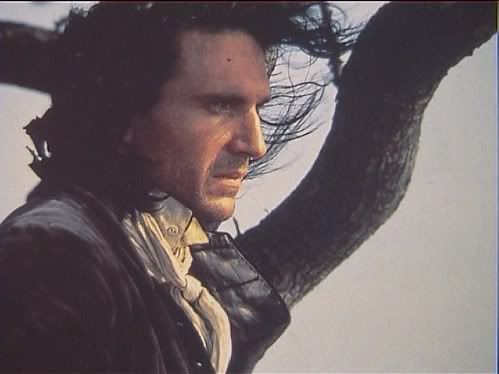
...We catch another glimpse of Heathcliff's past. He is crying out at the window, pleading with Cathy to come back (once more). Next, we learn much more about Heathcliff's childhood from Ellen Dean's story. Heathcliff is adopted by Mr. Earnshaw, and the family half-heartedly welcomes him. Hindley is extremely abusive to Heathcliff while Cathy becomes very attached to him. As they grow up, they face the loss of both mother and father. When Hindley returns from school, he has a wife and they are both abusive to Heathcliff. He is treated as a servant within his own "family." Cathy and Heathcliff continue to run wild, especially after Hindley's wife dies and he comes home drunk everyday. Even Hindley's own son, Hareton, is afraid of him.

Meanwhile, Cathy stays with the Lintons for awhile...and she comes back "a lady." Cathy thus befriends the Linton siblings, Edgar and Isabella. Heathcliff (jealous of the Lintons receiving Cathy's affections) does not care for Edgar--at all. The feeling is mutual, and their shared fondness for Cathy makes adds to their hatred for each other. Eventually, Edgar proposes to Cathy; she accepts, even though she knows it is the wrong decision. She says that she cannot marry Heathcliff because it would degrade her; and yet, she knows she loves him and that he is more of herself than she is. In other words, they are completely comfortable with each other, and Cathy can be herself when she is around Heathcliff. He knows her so well that she never has to explain herself, never has to be who she is not. She tells Nelly, "I am Heathcliff." Unfortunately, Heathcliff does not hear Cathy's profession of love, and he disappears into the night...After Cathy waits in the cold rain for Heathcliff to return, she gets sick. The Lintons nurse her back to health and the mother and father die. Cathy marries Edgar, and she and Nelly move to Thrushcross Grange. After three years of their marriage, Heathcliff returns. He visits the Grange, even though Edgar resents it. Surprisingly, Isabella becomes infatuated with Heathcliff. Cathy is completely against the match; she thinks Heathcliff would "devour" her.

Meanwhile, Nelly goes to visit Wuthering Heights. She finds Hareton to be a completely rugged little boy. He is raised by gamblers and alcoholics; Heathcliff teachers him to swear at his father and his father in turn beats him.

The DIRECTIONS your soul can take:
TG: society oriented; aristocratic virtue that is too narrow
WH: dark, depressing, dangerous; living in aristocratic vice
the moors: away from civilization and society; wild spirit


**Do we want a relationship with someone who is so completely like us?
Obviously, there are pros and cons to having such relationships...on the one hand, it could be a boring relationship, similar to talking to yourself all the time. In fact, it could go so far as to be suffocating. But still, there is something amazing about being with someone who is so like you that you are completely yourself when you are with that person.

**Good and bad are mixed in this novel; no person is completely good or completely bad. This results in moral ambiguity.

Wednesday, February 4, 2009

Notes 2/4

Wuthering Heights by Emily Bronte
Background on the Brontes...
...Emily, Charlotte, and Anne wrote under make pen names. The first reviewers thought these authors were male. Emily was later compared to Shakespeare (a female Shakespeare, interestingly enough, never mentioned by Virginia Woolf).

The First Two Chapters:
The atmosphere in these chapters is both dark and humorous at the same time. Wuthering Heights itself is a gloomy, foreboding place. The humorous aspect can be drawn from Joseph's religious fanaticism. Mr. Lockwood fancies himself a misanthrope (someone who hates other people) based upon his inability to return the feelings of a young lady whom he loved. When she returns his interest, he immediately withdraws into himself and actually starts to hate her. He humiliated her; she obviously retreated. And Mr. Lockwood thus gained the reputation of deliberate heartlessness. Loving something you can't have is a way of self-protection; if you know that your love will not be returned, you have nothing to lose...you will not get hurt if you cannot get close enough to be involved. Mr. Lockwood's obsession with Heathcliff is derived from his love of the unattainable. Heathcliff clearly seems as if he does not want to involve anyone in his life. Mr. Lockwood thus gets pleasure from being around and irritating Heathcliff.

Our impression of Heathcliff comes when Mr. Lockwood makes his first visit to Wuthering Heights. He is harsh towards his dog; his abrupt and cruel behavior is shown through his treatment of his dog(s). Heathcliff's behavior at this point seems unexplainable. As we progress through the novel, however, we discover the story of Heathcliff's depressing past...

In Chapter III:
maxillary convulsions: grinding your teeth because you are so angry; trying to keep from crying
...There is a scene where Mr. Lockwood pushes Heathcliff into maxillary convulsions.

Tuesday, February 3, 2009

poor Heathcliff...


...and I say poor Heathcliff because, so far, his life seems pretty wretched. As an adopted "gypsy" child, Heathcliff faces torment from his new brother Hindley from the moment he steps into the house. Heathcliff, however, bears the torture without tears; in fact, he remains a seemingly unfeeling character during the first few "chapters" of his childhood. He is hardened against the cruelties, and responds to Hindley only with cunning, non-physical threats. Now, this description thus far paints Heathcliff as a pathetic character on whom we should take unquestioning pity. As Heathcliff grows older, however, it gets more and more difficult to excuse his sullenness and general actions of rash conceit. By the time Mr. Lockwood encounters forty-something Heathcliff, the man is still handsome and in "good" health, but he is perhaps even more morose than in adolescence. He has a temper that seems quite difficult to control, and is not of the mind that guests should be spared from his oscillations between melancholy and fiery moods. Still, I feel sorry for Heathcliff...as I read on, I discover more and more reasons for his unhappiness, and can only help that Heathcliff will find some sort of consolation by the novel's end.

Monday, February 2, 2009

Notes 2/2

Julian Dibbell's "A Rape In Cyberspace"

Did Bungle commit rape?
This question initially invokes the question of whether or not Bungle is just a made-up character or and actual extension of the author. From there, we must move on to the fact the while it is a choice to be online, it is definitely not a choice to be raped. Even so, the made-up setting makes us think that these are all made-up actions, so the victims are not physically "real." And yet, even if it's not "real" the emotional investment is very similar. You can very well be traumatized by what you read and what you see. They can very well be life-altering. Additionally traumatizing is imagining the kinds of minds that come up with such material...

Furthermore, there is an emotional investment in being a character (an avatar). And when that emotional investment increases in intensity, real life and virtual reality begin to overlap and interact. Authors control the lives of characters; this is related to coming to terms with emotional investments in the virtual world

There are some things that are the same between cyber-rape and real rape, such as
psychological ramifications, the emotional investment, instituting some form of punishment, and the traumatizing encounter with the human imagination (and the monstrosity of it).

Saturday, January 31, 2009

"A Rape in Cyberspace"

*Did Mr. Bungle commit rape?
Obviously, Mr. Bungle is not guilty of committing rape in the traditional sense of the word. But I tend to agree with the view of Julian Dibbell, that Mr. Bungle did, indeed, commit rape. According to Dibbell, "since rape can occur without any physical pain or damage...then it must be classified as a crime against the mind." The seriousness of "cyber"rape is not something can be lightly brushed aside, since its emotional and psychological ramifications are obvious very real. Perhaps the more accurate terminology in describing Mr. Bungle's crime would follow more along the lines of verbal sexual assault. Regardless of the manner in viewing the issue (whether as rape or sexual harassment), however, the fact remains that the act itself remains that words and actions are too closely linked to be considered disparate entities, and thus the verbal and physical act of rape may have the same psychological consequences.

Friday, January 30, 2009

Notes 1/30

A Room of One's Own
by Virginia Woolf

Woolf asks 'Why hasn't there been a female Shakespeare?' She does on to answer her own question. Woolf declares that even if a woman had the same ability and creativity, she would not be able to take advantage of such qualities because writing and publishing were not within their social role. Furthermore, women did not have the same educational opportunities as men, and women weren't allowed to act on stage until the Restoration in 1660. Writing was also looked down upon because it was seen as a way for women to be around men, which was very improper at the time. Woolf even does so far as to tell her imagined tale of of Judith Shakespeare (William's sister) and how her desire to write and act led to her destruction.

Is it important to be a feminist in writing?
Woolf says that no one should write with a chip on his/her shoulder. Women are forced back into thinking about themselves and defining themselves as women; in her essay, she talks about being told to stay off the grass and stay out of the library because women were not allowed in those places. The ability to be an objective intellectual is made difficult because we are constantly being called back into the associations of our bodies. Men, however, are writing like men because they want to keep women as inferior subjects (they are feeling insecure because of the Women's Movement). And according to Woolf, being self-conscious about your sex makes you a lousy writer. Thus, ALL people (men and women alike) who write self-consciously of their sex are part of the problem. Woolf says that Shakespeare was such a great writer because he was neither a man nor a woman, and wrote as neither a man nor a woman.

Monday, January 26, 2009

Notes 1/26


Vindication of the Rights of Woman
Mary Wollstonecraft

Wollstonecraft took over the care of her family at young age. She started up and was governess of school (self-educated). She decided to try to write for a living, and wrote one of the first responses to a conservative piece by Edmund Burke. She called it Vindication of the Rights of Men (1789). At first it was published anonymously, and it read as if it was written by a man; she argues that it is irrational to distinguish among classes of men. She is defending the creation of a Republic (as opposed to a monarchy). In 1792, she publishes Vindication of the Rights Woman. The "woman" is singular, "men" is plural. To talk about the woman, she is generalizing all women. Either that, or she pointing to the woman as an individual. She describes women as a class of persons who have all been treated the same throughout time. Her term "man" is used to represent all individual humans, and is shorthand for "mankind." Now,however, the word"man" is avoided because the sub-texts are condescending.

In VR Woman, Wollstonecraft describes the system of sexism as structural and systematic. Society, through education, trains women not to be virtuous, not to be rational, not to manly. It trains women to be immoral and irrational. By believing the system, women are jeopardizing their cause.They must come up with ways to react within the confines of the system, and so they become cunning and tyrannical. According to Wollstonecraft, "Every profession involving subordination is highly injurious to morality."Perhaps the system of education injures morality on both a personal and financial level through such activities as plagiarism, cheating, paying off loans, and fitting in. Furthermore, once you stop thinking for yourself, your morality is injured.

According to Chapter 2, women are degraded because the education they receive is really given to them in order to make them (sexually) desirable. Soldiers are like women because they blindly submit to authority; they are educated to behave in the same way as women. She is saying that if you educate men in the same way you educated women, they will behave in the same way. Thus, women are NOT naturally inferior; they are NURTURED to be inferior. A social system has caused this "inferiority" of women. Rousseau declares that a woman should never feel a sense of independence. She replies "What nonsense!" especially because Rousseau is a radical who is working for the equality of men (social contract). He believes in equality of men--not of women.

In Chapter 3 the same subject is continued. Wollstonecraft tells us that women sometimes boast of their weakness in order to get (illegitimate, despotic) power over men; and example of this would be a puny appetite. Women, acting as despots, have more power by playing on the weakness of men than if they had legitimate, rational power. Some examples of this include crying, fainting, and sexual allure. Women are taught from infancy that being beautiful is what they are all about. "Adorning your gilt-cage" every time you work to "beautify" yourself is the ultimate goal for all women.

Basically, this is feminism insisting that women have been given too much, and it is their turn to work, to do something legitimate in order to gain equality and power. Wollstonecraft is very hard on women, forcing them to look at their mistakes and correct them.