Monday, February 16, 2009

Notes 2/16

Wuthering Heights in Scholarly Articles and Films
Watching different versions of Wuthering Heights and reading scholarly articles on the text have brought forth new ideas about the novel...For example, Heathcliff is compared to Frankenstein, Catherine's love for Heathliff is seen as transcendental, and the allusion to cannibalism is made clear.

Is the scholarly article a medium that is going to keep literature alive?
Well, most people are probably not going to go out and read scholarly articles just for "fun." However, these articles are not generally written for the "average" person...they are intended for "intellectuals." The people who write these articles are writing to people who have learned the same things...they are essentially writing for their own elite group.

So, how do we make scholarship relevant and humane?
The scholar would have to translate their words and ideas into ordinary English; this would ensure that they are saying something that is relevant and real. The "curtain" would continue to be parted, each level being more complicated than the next. Perhaps this would save scholarly articles...perhaps. It's a bit like going back and forth between Wikipedia and a more complex article.

Movie Versions
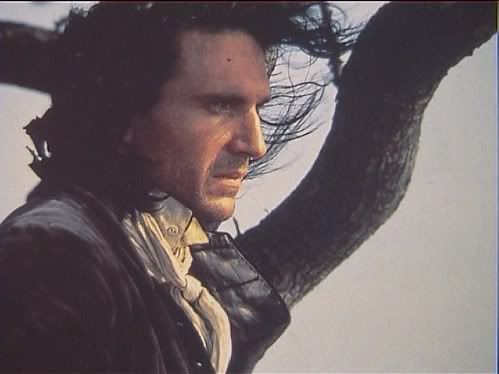
In the 1992 film version of Wuthering Heights, the same actress is used to play Catherine and Cathy. This emphasizes that fact that Heathcliff is completely absorbed by thoughts of Catherine and that she remains a heightened aspect of his everyday life. This also shows that interrelatedness of love and hate--he cannot stand the sight of young Cathy, and yet she reminds him of the Catherine he so fervently loves.

In Chapter XV, the confrontation between Catherine and Heathcliff (as she is on her deathbed) focuses in on the reason that Catherine chose empirical love over transcendental love. Clearly, Heathcliff is furious with Catherine for choosing Edgar; and yet, he still passionately loves her. This balance between love/hate can be shown in the movie because of the dual role played by Cathy/Catherine.

Another unique aspect of the film is the ability to see the facial expressions and non-verbal communication between the characters, something not "seen'' in the novel. The 1939 version is not as dark, and turns Catherine's death scene into something much more romantic, and we are able to forgive both characters. This version even leaves out the second volume of the novel, and thus turns the tale into a completely romantic story, taking off the dark edge.

Why would Emily Bronte want to write a dark romance?
Perhaps she is attempting to create a more realistic version of the Cinderella fairy tale. Or maybe she wants to show the possibility of having both an empirical and transcendental love; and the necessity of sharing your life/children with your empirical love while at the same time retaining a strong, unbreakable bond with your transcendental love. So, who should you marry? I would have to say I would want to marry my soulmate. A feel that any other choice would leave me with a lifetime of regret...

Should we condemn Catherine for wanting both kinds of love?
Well, she's not being fair to either man...and yet, it is easy to identify with Catherine for wanting both a soulmate and a socially stable life.

Sunday, February 15, 2009

Understanding Heathcliff


Although films can never adequately represent novels, it is always worthwhile to give the movies a chance. Even if the movie is a genuine dud, it at least offers some sort of new perspective upon the original literature. In the case of Peter Kosminsky’s Wuthering Heights, the film does a fairly good job of portraying the plot and staying true to the dialogue, but it lacks the sheer depth that the novel encompasses. Even so, Kosminksky’s version does shed light upon Heathcliff’s death, a scene in the novel that we can only witness from the narrator’s limited point of view. In the film, we see Heathcliff’s death as the climactic conclusion to the complete manifestation of Catherine within his life.

The book allows for us to imagine such an overwhelming obsession only through the observations of Nelly Dean. But in the film, we are given wider access to Heathcliff’s thoughts and actions. In the film, for example, we are able to see Heathcliff dictating the letter that Linton is to send to young Cathy. As Heathcliff decides what the letter should say, his expression of longing (which goes hand in hand with the words of desire) illustrates his inability to separate Catherine from any aspect of his life. Indeed, it seems as if he is writing a letter to Catherine from Heathcliff, not to Cathy from Linton. This is different from the letter scene in the novel—here, we only learn what Nelly Dean thinks of the letters, and never actually “see” Heathcliff writing them. Thus, the scene in the film expands out understanding of Heathcliff’s complete and overwhelming obsession with Catherine.

The film also emphasizes Heathcliff’s inability to shed thoughts of Catherine by reflecting her very image in the face of her daughter. Although this goes against the novel—where Cathy shares only her forehead, eyes, and nostrils with her deceased mother— Kosminsky makes a wise choice increasing the level of likeness between the two Catherines. In fact, the parts are even played by the same actress. This aspect of the film highlights the fact that Heathcliff cannot escape his past and is continually haunted by tangible images of Catherine. The resemblance obviously has a profound effect upon Heathcliff, as we see that he cannot bear to have her in his sight.

As viewers, we share Heathcliff’s shock in confronting the uncanny resemblance between the two women, and thus share his pain in being reminded of the past. If it weren’t for their different hair colors, I would have trouble distinguishing between young Cathy and an apparition of the late Catherine. This creates an area of hazy identification, and thus serves to explain the profound effect Cathy’s presence has upon Heathcliff—severe enough, perhaps, to drive him to an earlier death. In the novel, for example, Heathcliff sneeringly tells Cathy, “Well, there is one who wont shrink from my company! By God! She’s relentless. Oh, damn it! It’s unutterably too much for flesh and blood to bear—even mine” (396). Clearly, Heathcliff is steadily reaching the point where even he must admit that the overbearing presence Catherine has within his life is taking a toll upon his ability to exist. In the film, this is emphasized by the constant presence of Cathy/Catherine, as well as in the expressions of longing and desperation upon Heathcliff’s face whenever he talks about her.

These aspects of the film (neither of which we can “see” by reading the novel) serve to enhance out understanding of Heathcliff’s death scene. In the novel, we are given only Nelly Dean’s account of how she finds Heathcliff after he has died. We are not there to witness his death, so we left to discern what we can from Nelly’s description of his open eyes, parted lips, and sneering teeth. In the movie, however, we are with Heathcliff when he dies. He enters the room as if led by the apparition of Catherine. As he opens the doors, the room floods with light, and suddenly he is embracing Catherine out on the moors. As spectators to this scene, we are able to see the driving force behind Heathcliff’s death—his desire to be with Catherine. Obviously, this idea can be conjectured from the text, but it highlighted and emphasized within the film. When Heathcliff talks about the “change” he is about to experience (in the novel) we are left to guess why that change is going to occur. After watching such a scene, and knowing that Heathcliff has been consumed with thoughts and images of Catherine since her death (as the film portrays), there is no doubt that it is the complete and total domination of Catherine within Heathcliff’s life that ultimately brings about the “change” Heathcliff experiences in his death.

Monday, February 9, 2009

Notes 2/9: Through Volume I

The relationship between Cathy and Ellen:
Ellen has grown up with Cathy, but they are not linked by a strong bond of friendship. Ellen recognizes the flaws in Cathy, and Cathy feels the need to control Ellen (as a servant).

Seeking Revenge
Cathy is not with Heathcliff because he would degrade her. Heathcliff says that Cathy should have married him, and that he will have his revenge upon Edgar for "stealing" Catherine. This will also serve to aid Heathcliff in his revenge against the higher classes of society. Additionally, Heathcliff wants to hurt Hindley for the pains he caused him in the past--particularly that Hindley was the one who so degraded Heathcliff that he could not marry Cathy. To seek his revenge on Hindley, Heathcliff makes Hindley's son hate him. He is also systematically taking Hindley's property from him through gambling and bets.

Does Heathcliff obtain bliss from inflicting pain?
Heathcliff doesn't necessarily seek the bliss from the pain; rather, he is retaliating against the wrongs he has suffered in his youth. He definitely does not want to inflict pain upon Catherine. He wants and is satisfied by his revenge, but it does not seem as if Heathcliff actually finds joy in anything.

**Heathcliff and Catherine NEED each other to survive... is that kind of love oppressive?

Friday, February 6, 2009

Notes 2/6

Chapters III-X
...We catch another glimpse of Heathcliff's past. He is crying out at the window, pleading with Cathy to come back (once more). Next, we learn much more about Heathcliff's childhood from Ellen Dean's story. Heathcliff is adopted by Mr. Earnshaw, and the family half-heartedly welcomes him. Hindley is extremely abusive to Heathcliff while Cathy becomes very attached to him. As they grow up, they face the loss of both mother and father. When Hindley returns from school, he has a wife and they are both abusive to Heathcliff. He is treated as a servant within his own "family." Cathy and Heathcliff continue to run wild, especially after Hindley's wife dies and he comes home drunk everyday. Even Hindley's own son, Hareton, is afraid of him.

Meanwhile, Cathy stays with the Lintons for awhile...and she comes back "a lady." Cathy thus befriends the Linton siblings, Edgar and Isabella. Heathcliff (jealous of the Lintons receiving Cathy's affections) does not care for Edgar--at all. The feeling is mutual, and their shared fondness for Cathy makes adds to their hatred for each other. Eventually, Edgar proposes to Cathy; she accepts, even though she knows it is the wrong decision. She says that she cannot marry Heathcliff because it would degrade her; and yet, she knows she loves him and that he is more of herself than she is. In other words, they are completely comfortable with each other, and Cathy can be herself when she is around Heathcliff. He knows her so well that she never has to explain herself, never has to be who she is not. She tells Nelly, "I am Heathcliff." Unfortunately, Heathcliff does not hear Cathy's profession of love, and he disappears into the night...After Cathy waits in the cold rain for Heathcliff to return, she gets sick. The Lintons nurse her back to health and the mother and father die. Cathy marries Edgar, and she and Nelly move to Thrushcross Grange. After three years of their marriage, Heathcliff returns. He visits the Grange, even though Edgar resents it. Surprisingly, Isabella becomes infatuated with Heathcliff. Cathy is completely against the match; she thinks Heathcliff would "devour" her.

Meanwhile, Nelly goes to visit Wuthering Heights. She finds Hareton to be a completely rugged little boy. He is raised by gamblers and alcoholics; Heathcliff teachers him to swear at his father and his father in turn beats him.

The DIRECTIONS your soul can take:
TG: society oriented; aristocratic virtue that is too narrow
WH: dark, depressing, dangerous; living in aristocratic vice
the moors: away from civilization and society; wild spirit


**Do we want a relationship with someone who is so completely like us?
Obviously, there are pros and cons to having such relationships...on the one hand, it could be a boring relationship, similar to talking to yourself all the time. In fact, it could go so far as to be suffocating. But still, there is something amazing about being with someone who is so like you that you are completely yourself when you are with that person.

**Good and bad are mixed in this novel; no person is completely good or completely bad. This results in moral ambiguity.

Wednesday, February 4, 2009

Notes 2/4

Wuthering Heights by Emily Bronte
Background on the Brontes...
...Emily, Charlotte, and Anne wrote under make pen names. The first reviewers thought these authors were male. Emily was later compared to Shakespeare (a female Shakespeare, interestingly enough, never mentioned by Virginia Woolf).

The First Two Chapters:
The atmosphere in these chapters is both dark and humorous at the same time. Wuthering Heights itself is a gloomy, foreboding place. The humorous aspect can be drawn from Joseph's religious fanaticism. Mr. Lockwood fancies himself a misanthrope (someone who hates other people) based upon his inability to return the feelings of a young lady whom he loved. When she returns his interest, he immediately withdraws into himself and actually starts to hate her. He humiliated her; she obviously retreated. And Mr. Lockwood thus gained the reputation of deliberate heartlessness. Loving something you can't have is a way of self-protection; if you know that your love will not be returned, you have nothing to lose...you will not get hurt if you cannot get close enough to be involved. Mr. Lockwood's obsession with Heathcliff is derived from his love of the unattainable. Heathcliff clearly seems as if he does not want to involve anyone in his life. Mr. Lockwood thus gets pleasure from being around and irritating Heathcliff.

Our impression of Heathcliff comes when Mr. Lockwood makes his first visit to Wuthering Heights. He is harsh towards his dog; his abrupt and cruel behavior is shown through his treatment of his dog(s). Heathcliff's behavior at this point seems unexplainable. As we progress through the novel, however, we discover the story of Heathcliff's depressing past...

In Chapter III:
maxillary convulsions: grinding your teeth because you are so angry; trying to keep from crying
...There is a scene where Mr. Lockwood pushes Heathcliff into maxillary convulsions.

Tuesday, February 3, 2009

poor Heathcliff...


...and I say poor Heathcliff because, so far, his life seems pretty wretched. As an adopted "gypsy" child, Heathcliff faces torment from his new brother Hindley from the moment he steps into the house. Heathcliff, however, bears the torture without tears; in fact, he remains a seemingly unfeeling character during the first few "chapters" of his childhood. He is hardened against the cruelties, and responds to Hindley only with cunning, non-physical threats. Now, this description thus far paints Heathcliff as a pathetic character on whom we should take unquestioning pity. As Heathcliff grows older, however, it gets more and more difficult to excuse his sullenness and general actions of rash conceit. By the time Mr. Lockwood encounters forty-something Heathcliff, the man is still handsome and in "good" health, but he is perhaps even more morose than in adolescence. He has a temper that seems quite difficult to control, and is not of the mind that guests should be spared from his oscillations between melancholy and fiery moods. Still, I feel sorry for Heathcliff...as I read on, I discover more and more reasons for his unhappiness, and can only help that Heathcliff will find some sort of consolation by the novel's end.

Monday, February 2, 2009

Notes 2/2

Julian Dibbell's "A Rape In Cyberspace"

Did Bungle commit rape?
This question initially invokes the question of whether or not Bungle is just a made-up character or and actual extension of the author. From there, we must move on to the fact the while it is a choice to be online, it is definitely not a choice to be raped. Even so, the made-up setting makes us think that these are all made-up actions, so the victims are not physically "real." And yet, even if it's not "real" the emotional investment is very similar. You can very well be traumatized by what you read and what you see. They can very well be life-altering. Additionally traumatizing is imagining the kinds of minds that come up with such material...

Furthermore, there is an emotional investment in being a character (an avatar). And when that emotional investment increases in intensity, real life and virtual reality begin to overlap and interact. Authors control the lives of characters; this is related to coming to terms with emotional investments in the virtual world

There are some things that are the same between cyber-rape and real rape, such as
psychological ramifications, the emotional investment, instituting some form of punishment, and the traumatizing encounter with the human imagination (and the monstrosity of it).